Ostrich – The Giant of the Bird World
The ostrich is one of nature’s most fascinating wonders — a bird that defies expectations. Towering over all other birds, this extraordinary creature is flightless yet incredibly fast, powerful yet graceful. Native to Africa’s vast landscapes, the ostrich has captivated humans for centuries with its size, speed, and unique adaptations for survival. From its enormous eyes to its thunderous stride, every aspect of the ostrich tells a story of evolution’s ingenuity.
Fun Facts
• Largest Bird on Earth – The ostrich holds the title as the world’s biggest living bird.
• Incredible Runner – It can sprint at speeds of up to 70 km/h (43 mph), making it the fastest bird on land.
• Massive Eggs – Ostrich eggs are the largest of any bird species and can weigh over 1.5 kg.
• Huge Eyes – Their eyes are among the largest of any land animal, even bigger than their brains.
• Powerful Kick – An ostrich’s kick is strong enough to seriously injure predators.
• Two-Toed Feet – Unlike most birds, ostriches have only two toes, designed for speed and stability.
Scientific Information
Common Name: Ostrich
Scientific Name: Struthio camelus
Classification: Bird (Flightless)
Family: Struthionidae
Habitat: Savannas, semi-deserts, open woodlands
Diet: Omnivorous (plants, seeds, insects, small animals)
Lifespan: Typically 30–40 years in the wild
Height: Up to 2.7 meters (9 feet)
Weight: 90–150 kg
Ostriches belong to a group of flightless birds known as ratites, which also includes emus and kiwis. Their flat breastbone lacks the keel structure needed for flight muscles, explaining why they cannot fly.
Habits & Behavior
Ostriches are highly adapted for life on open plains:
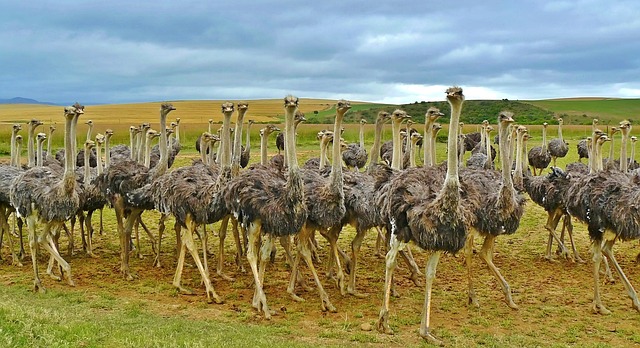
• Social Structure – They often live in small groups or loose herds, sometimes mingling with grazing mammals like zebras and antelopes.
• Defense Strategy – Instead of hiding, ostriches rely on speed and powerful kicks to escape or deter threats.
• Excellent Vision – Their elevated height and large eyes allow them to detect danger from great distances.
• Unique Reproduction – Several females may lay eggs in a shared nest, guarded by a dominant male and female.
• Thermoregulation – Ostriches can tolerate extreme heat by adjusting blood flow and using wing movements to cool down.
• Curious Nature – They are known to investigate unfamiliar objects in their environment.
Despite common myths, ostriches do not bury their heads in the sand. This misconception likely arose from their habit of lowering their heads to turn eggs or inspect the ground.
Is the Ostrich a National Bird?
The ostrich is not officially recognized as the national bird of any country. However, it holds strong cultural and symbolic significance in several African nations where it naturally occurs. It frequently appears in folklore, art, and traditional symbolism, representing speed, strength, and resilience.