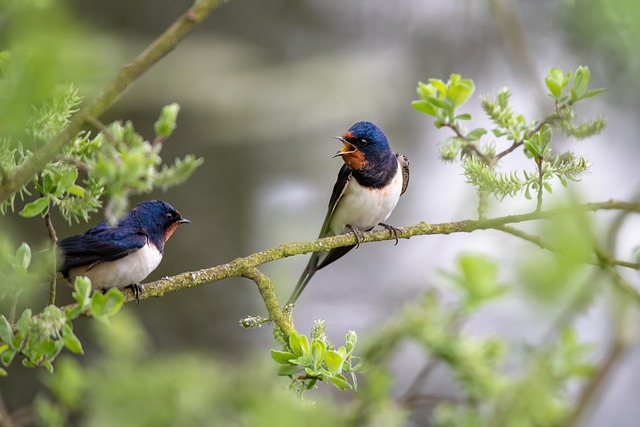
Barn Swallow – The Graceful Messenger of the Skies
The Barn Swallow is one of the most familiar and widely distributed birds in the world. With its glossy blue back, cinnamon-colored throat, and deeply forked tail, this elegant flier is often seen swooping low over fields, lakes, and villages. Known for its remarkable migration journeys and close relationship with humans, the Barn Swallow symbolizes hope, renewal, and the arrival of spring in many cultures.
Although admired across continents, the Barn Swallow is not officially the national bird of any country. However, it holds strong cultural significance in Europe, Asia, and North America.
Fun Facts
- Long-Distance Traveler: Barn Swallows migrate thousands of kilometers between breeding and wintering grounds each year.
- Human-Friendly Bird: They often build nests in barns, bridges, and under house eaves—hence the name “Barn” Swallow.
- Aerial Acrobat: They can catch insects mid-air with impressive speed and agility.
- Loyal Nesters: Many Barn Swallows return to the same nesting site year after year.
- Cheerful Song: Their song is a pleasant series of chirps and warbles, often heard during flight.
Scientific Information
- Scientific Name: Hirundo rustica
- Family: Hirundinidae
- Order: Passeriformes
- Class: Aves
- Average Length: 17–19 cm (including tail streamers)
- Wingspan: 32–34 cm
- Weight: 16–22 grams
- Diet: Flying insects such as flies, beetles, wasps, and mosquitoes
- Lifespan: Typically 4–8 years in the wild
- Conservation Status: Least Concern (IUCN)
The Barn Swallow is considered a passerine bird (perching bird) and is one of the most widespread swallow species in the world.
Habits & Behavior
Migration
Barn Swallows are famous for their long migratory journeys. Birds breeding in Europe and Asia often travel to Africa, while North American populations migrate to Central and South America. They rely heavily on favorable weather patterns and abundant insect populations during migration.
Nesting
They build cup-shaped nests made of mud pellets mixed with grass and lined with feathers. These nests are usually attached to vertical surfaces in sheltered places such as barns, sheds, and bridges.
Social Nature
Barn Swallows are social birds, especially during migration and in winter, when they gather in large communal roosts.
Feeding Behavior
They feed almost entirely on flying insects, catching them in mid-air. Their streamlined bodies and long pointed wings make them exceptional aerial hunters.
Breeding
During breeding season, males perform flight displays to attract females. They are generally monogamous, and both parents take part in feeding the chicks.
Symbolism & Cultural Importance
In many cultures, the Barn Swallow represents:
- Hope and renewal
- Good luck
- Safe return home
- The arrival of spring
Because they return faithfully to the same nesting areas, they are often seen as symbols of loyalty and homecoming.
The Barn Swallow is truly a bird of grace, resilience, and beauty. Whether gliding over open fields or nesting near human homes, this small yet mighty traveler continues to charm bird lovers around the world.