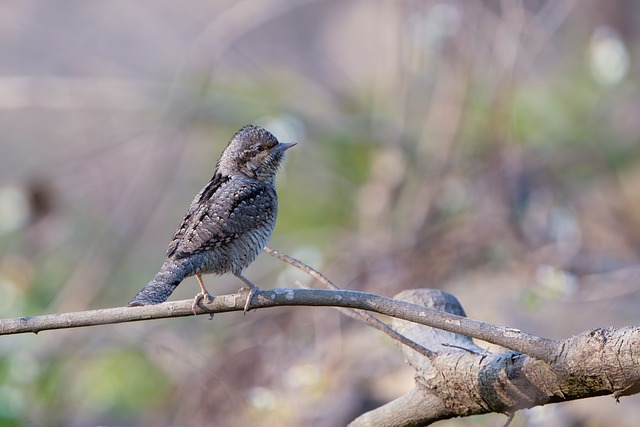
Wryneck: The Master of Camouflage with a Snake-Like Twist
The Wryneck is one of the most unusual members of the woodpecker family. Unlike most woodpeckers, it rarely pecks tree trunks or climbs vertically. Instead, it spends much of its time on the ground searching for ants and other small insects. Its beautifully mottled brown, gray, and black feathers provide excellent camouflage, allowing it to blend seamlessly into tree bark and leaf litter.
The Wryneck gets its name from its remarkable ability to twist and rotate its neck in a snake-like manner when threatened. This fascinating defensive display has made it one of the most distinctive birds in the world. Found across Europe, Asia, and parts of Africa, the Wryneck is a migratory bird that plays an important role in maintaining healthy insect populations.
Fun Facts
- Snake Mimic: When threatened, the Wryneck twists its neck, hisses, and sways its head like a snake to scare away predators.
- A Woodpecker That Doesn’t Peck: Although it belongs to the woodpecker family, it rarely drills into wood.
- Ant Specialist: Ants and their larvae make up the majority of its diet.
- Long-Distance Traveler: Many Wrynecks migrate thousands of kilometers between Europe and Africa each year.
- Natural Camouflage: Its bark-like plumage makes it incredibly difficult to spot while resting on trees.
- Uses Existing Cavities: Instead of carving its own nest, it usually nests in abandoned woodpecker holes or natural tree cavities.
- Unique Call: Its repetitive, sharp “quee-quee-quee” call is often heard before the bird is seen.
- Excellent Defense: Besides twisting its neck, it may puff up its feathers and spread its tail to appear larger.
Scientific Info
| Category | Information |
| Common Name | Wryneck |
| Scientific Name | Jynx torquilla |
| Family | Picidae (Woodpeckers) |
| Genus | Jynx |
| Order | Piciformes |
| Class | Aves |
| Diet | Mainly ants, ant larvae, beetles, spiders, and other insects |
| Length | 16–18 cm (6.3–7.1 inches) |
| Wingspan | 25–30 cm (9.8–11.8 inches) |
| Weight | 30–50 g (1.1–1.8 oz) |
| Lifespan | Typically 2–6 years in the wild |
| Habitat | Open woodlands, orchards, parks, forest edges, and grasslands with scattered trees |
| Distribution | Europe, Asia, North Africa; winters mainly in sub-Saharan Africa and South Asia |
| Conservation Status | Least Concern (IUCN) |
Habits & Behavior
The Wryneck is a quiet and secretive bird that prefers staying hidden among trees or on the ground. Rather than behaving like a typical woodpecker, it spends much of its day searching for ants by probing the soil with its long, sticky tongue.
It is most active during daylight hours and often remains motionless when danger approaches, relying on its excellent camouflage. If a predator gets too close, the bird performs its famous snake-like display by twisting its neck, hissing, and moving its head dramatically to intimidate the threat.
During the breeding season, Wrynecks form monogamous pairs and nest in tree cavities, nest boxes, or abandoned woodpecker holes. The female typically lays 7–12 white eggs, and both parents share incubation and feeding duties.
Wrynecks are migratory across much of their range, traveling long distances between breeding and wintering grounds. They are generally solitary outside the breeding season and are more often heard than seen due to their distinctive repeated calls.
Despite belonging to the woodpecker family, the Wryneck has evolved a unique lifestyle centered around ground feeding, camouflage, and remarkable defensive behavior, making it one of the most fascinating birds in the world.