Snipe: The Secretive Master of the Wetlands
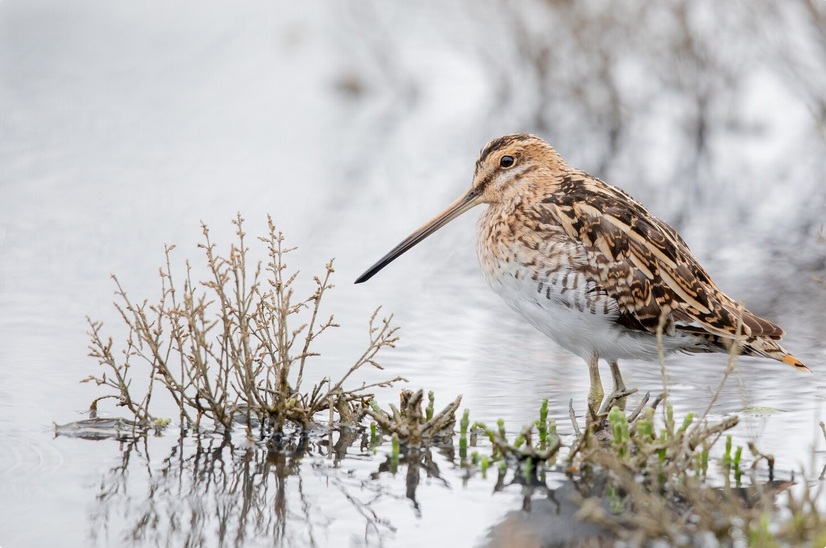
The Snipe is a fascinating group of medium-sized wading birds known for their remarkably long bills, beautifully camouflaged plumage, and sudden, zigzagging flight. Found mainly in wetlands, marshes, wet grasslands, muddy fields, and the edges of ponds and streams, snipes are often difficult to spot because their brown, buff, and striped feathers blend perfectly with their surroundings.
Snipes belong to the sandpiper family, Scolopacidae, within the order Charadriiformes. One well-known species is the Wilson’s Snipe (Gallinago delicata), which is widespread in North America.
These secretive birds spend much of their time quietly searching through soft mud for food. Their exceptionally long bills are perfectly adapted for probing wet soil and locating insect larvae, worms, and other small invertebrates. During breeding season, males can perform spectacular aerial displays, producing a distinctive humming or whistling sound called “winnowing” with their tail feathers.
Fun Facts
- Amazing camouflage: Snipe have intricate brown, buff, and striped plumage that helps them disappear into marsh vegetation and muddy ground.
- A remarkable bill: Their long, sensitive bills allow them to probe deep into soft soil for hidden prey.
- They can “see behind”: The eyes of Wilson’s Snipe are positioned far back on the head, giving the bird an exceptionally wide field of vision.
- Fast and unpredictable: When startled, a snipe can burst suddenly from cover and fly away in a rapid zigzag pattern.
- The mysterious winnowing sound: During aerial displays, air passing over modified outer tail feathers produces a distinctive humming or whistling sound.
- Powerful flyers: Wilson’s Snipe can reach speeds estimated at more than 60 mph (97 km/h).
- Mostly active at dawn and dusk: Snipes commonly forage around the early morning and evening.
- The word “sniper” has an interesting connection: The term is historically linked to hunters pursuing snipe because of the bird’s difficult, erratic flight. (All About Birds)
Scientific Information
Common Name: Snipe
Example Species: Wilson’s Snipe
Scientific Name: Gallinago delicata
Order: Charadriiformes
Family: Scolopacidae
Bird Type: Shorebird / Wading Bird
Habitat: Marshes, wetlands, wet meadows, pond edges, riversides, and damp fields
Diet: Insect larvae, worms, insects, snails, crustaceans, and other small invertebrates
Nesting: Ground
Conservation Status: Wilson’s Snipe is currently considered Low Concern.
Wilson’s Snipe typically measures about 27–32 cm (10.6–12.6 inches) in length, with a wingspan of approximately 41–44 cm (16.1–17.3 inches). Its body is relatively chunky, while its straight bill is several times longer than its head.
The bird’s diet consists primarily of invertebrates. It uses its bill to probe wet soil and can even grasp and swallow small prey while the bill remains underground.
Habits & Behavior
Feeding Behavior
Snipe are expert wetland foragers. They slowly walk through soft ground, repeatedly pushing their long bills into the mud to locate insect larvae, worms, and other prey. Their sensitive bill tips help them detect food beneath the surface.
Flight
Although they can appear somewhat stocky when standing, snipes are powerful flyers. When disturbed, they often explode suddenly from vegetation and fly away in a characteristic fast, twisting, zigzag pattern.
Courtship Display
One of the most spectacular behaviors of the snipe is its aerial courtship display. A male may climb high above its territory before diving and circling through the air. As air moves rapidly across its specially modified outer tail feathers, it creates the famous winnowing sound.
Breeding
Wilson’s Snipe nests on the ground, usually in concealed locations among grasses and wetland vegetation. The female typically lays 2–4 eggs, and incubation lasts approximately 18–20 days. The chicks are able to leave the nest on the day they hatch.
Habitat & Survival
Snipes depend heavily on healthy wetlands and other damp habitats. Marshes, wet meadows, muddy pond margins, and similar environments provide both food and cover. Loss or conversion of wetlands can therefore negatively affect their populations.
The Snipe is a true master of camouflage—quiet, elusive, and almost invisible until it suddenly bursts from the marsh in a spectacular display of speed and agility.