Titmouse: The Tiny Songbird with a Big Personality
The Titmouse is a charming group of small, active songbirds known for their distinctive crests, curious nature, and lively calls. Found mainly across North America, titmice are frequent visitors to forests, woodlands, parks, gardens, and backyard bird feeders. Their rounded bodies, large eyes, and energetic movements make them a favorite among birdwatchers.
Although “titmouse” is commonly used for several species, the Tufted Titmouse is one of the best-known members of the group. These birds are highly social and often travel through trees in small mixed-species flocks, searching for insects, seeds, berries, and other food.
With their cheerful calls and constant activity, titmice bring life and character to woodland habitats. Their distinctive sounds are especially noticeable in quiet forests and suburban backyards.
Fun Facts
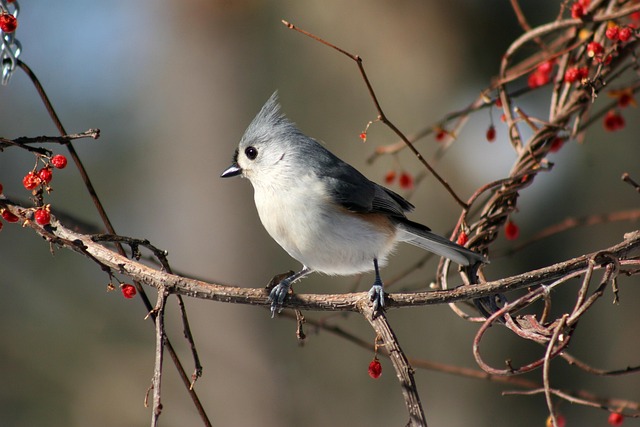
- A crested songbird: The Tufted Titmouse is easily recognized by its prominent pointed crest.
- Excellent tree climbers: Titmice move skillfully through branches while searching for food.
- Food-caching experts: They may carry seeds and nuts away and hide them for later use.
- Very curious: Titmice are often quick to investigate new objects, sounds, and visitors.
- Many vocalizations: They use different calls to communicate with mates, family members, and other birds.
- Helpful insect hunters: During the breeding season, insects and caterpillars become an important part of their diet.
- Social birds: Titmice may join mixed-species flocks with chickadees, nuthatches, and other woodland birds.
- Backyard visitors: They readily visit bird feeders, particularly where sunflower seeds and other suitable foods are available.
- Cavity nesters: They commonly nest in natural tree cavities or abandoned woodpecker holes.
- Active throughout the year: In many parts of their range, titmice remain in the same general area year-round rather than undertaking long migrations.
Scientific Information
Common Name: Titmouse
Family: Paridae
Order: Passeriformes
Class: Aves
The name “titmouse” refers to a group of small passerine birds in the family Paridae. The Tufted Titmouse (Baeolophus bicolor) is one of the most familiar species.
Adult Tufted Titmice are generally around 15–17 cm (6–6.7 inches) long, with a rounded body, gray back, pale underside, dark forehead, and a distinctive pointed crest. They have short, rounded wings and a relatively long tail that help them maneuver efficiently among trees.
Titmice have strong, pointed bills suited for cracking seeds and handling insects. Their diet varies seasonally and includes insects, caterpillars, seeds, nuts, berries, and other plant material.
Habits & Behavior
Titmice are active, agile, and highly alert birds. They spend much of their time moving through trees and shrubs in search of food. Rather than remaining in one location for long periods, they frequently hop from branch to branch and inspect bark, leaves, and twigs.
Feeding Behavior
Titmice eat a combination of insects and plant foods. During warmer months, they consume many insects and caterpillars, while seeds and nuts become particularly important at other times of the year.
They often carry large food items to another location before eating them. Some food may also be hidden in cracks, crevices, or other concealed places for later consumption.
Social Behavior
Outside the breeding season, titmice can become part of mixed-species foraging flocks. They may travel with chickadees, nuthatches, woodpeckers, and other small woodland birds. These groups can provide increased opportunities to find food and may help birds detect predators.
Communication
Titmice are highly vocal. Their calls include clear whistles, contact calls, alarm calls, and other sounds used to maintain communication with nearby birds.
Their familiar whistled songs can carry surprisingly far through woodland habitats, making their presence easy to detect even when the birds themselves are hidden among foliage.
Breeding and Nesting
During the breeding season, pairs establish territories and usually nest in tree cavities. They may use natural cavities or old woodpecker holes, sometimes adding soft materials such as fur to create a comfortable nest.
The female lays a clutch of eggs and incubates them, while the male helps provide food. After hatching, both parents participate in feeding and caring for the young.
Habitat
Titmice prefer deciduous and mixed forests, woodland edges, parks, orchards, and mature suburban areas with plenty of trees. Their ability to adapt to human-dominated landscapes has helped them become familiar backyard birds in many regions.
The Titmouse may be small in size, but its bold personality, distinctive crest, beautiful calls, and fascinating behavior make it one of the most enjoyable songbirds to observe. Whether heard calling from a woodland canopy or seen visiting a backyard feeder, the Titmouse is a delightful part of the bird world.