Chiffchaff – The Tiny Warbler with a Distinctive Song
The Chiffchaff is a small, active songbird famous for its simple but unmistakable “chiff-chaff, chiff-chaff” song. Despite its tiny size and rather plain appearance, this little warbler is one of the most recognizable woodland birds across Europe and parts of Asia.
The name “Chiffchaff” comes from the characteristic sound of its song, which is often repeated steadily from trees and bushes. It is an energetic bird that spends much of its time searching for tiny insects among leaves and branches.
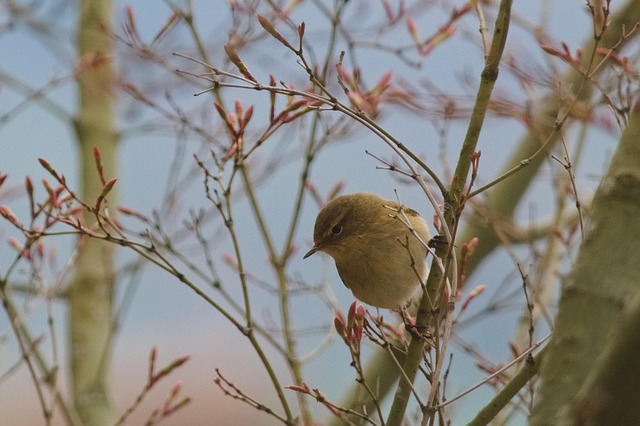
The Chiffchaff belongs to the leaf warbler family (Phylloscopidae) and is closely associated with woodland edges, gardens, parks, scrubland, and other areas with plenty of vegetation. Its small size, olive-brown plumage, dark legs, and constant movement make it an interesting bird to observe.
Its distinctive song also makes the Chiffchaff particularly popular among birdwatchers and bird-sound enthusiasts.
Fun Facts
- Its name comes from its song: The familiar “chiff-chaff” sound is the reason this bird received its common name.
- Very small bird: The Chiffchaff is only around 10–11 cm long, making it smaller than many familiar garden birds.
- Always on the move: It frequently hops and flits between leaves and branches while searching for food.
- Insect hunter: Small insects, larvae, spiders, and other tiny invertebrates make up much of its diet.
- Simple but recognizable: Unlike some birds with complex songs, the Chiffchaff’s repeated two-syllable song is remarkably easy to recognize.
- Some migrate, some stay: Depending on the population and region, Chiffchaffs may migrate seasonally, while some remain in their breeding areas throughout the year.
- Often heard before seen: Its repetitive song can reveal its presence even when the bird is hidden among dense foliage.
- Widely distributed: Chiffchaffs occur across large parts of Europe and Asia, with several closely related forms and species.
Scientific Information
Common Name: Chiffchaff
Scientific Name: Phylloscopus collybita
Family: Phylloscopidae
Genus: Phylloscopus
Order: Passeriformes
Type: Small songbird / Leaf warbler
Length: Approximately 10–11 cm
Diet: Mainly insects and other small invertebrates
Habitat: Woodlands, woodland edges, scrub, parks, gardens, and areas with dense vegetation
The Common Chiffchaff (Phylloscopus collybita) is a small passerine bird belonging to the leaf warbler family, Phylloscopidae. It is closely related to several other Phylloscopus warblers and is part of a group of closely related Chiffchaff forms and species.
Its plumage is generally olive-green or brownish above and pale below. The bird has a relatively short, fine bill and usually appears more subdued in color than many other songbirds. Its small size and active behavior help distinguish it from larger warblers.
Habits & Behavior
Chiffchaffs are active and agile insect hunters. They spend much of their time moving through trees and shrubs, carefully inspecting leaves and branches for small insects and other prey.
They often flick their wings or tail while moving through vegetation and can be surprisingly difficult to follow with the eyes because of their constant movement.
During the breeding season, males become highly vocal and repeatedly sing from suitable perches to establish and defend their territories and attract mates.
Chiffchaffs generally build their nests close to the ground, often hidden among dense vegetation. The female typically constructs a domed nest using materials such as grass, moss, leaves, and other plant matter.
Outside the breeding season, Chiffchaffs may become less territorial and can be found in a wider variety of habitats, including gardens, parks, hedgerows, and areas with suitable vegetation.
Chiffchaff Sound
The Chiffchaff is particularly famous for its distinctive song: a repeated “chiff-chaff, chiff-chaff” rhythm. The song is relatively simple, but its clear and repetitive pattern makes the bird easy to identify by ear.
For bird-sound enthusiasts, the Chiffchaff is an excellent example of how a bird can be identified not only by its appearance but also by its unique vocal signature.