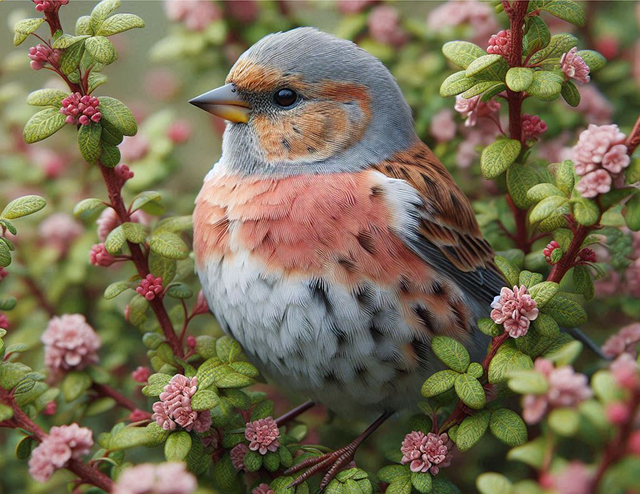
Linnet — The Charming Songbird of Open Countryside
The Linnet (Linaria cannabina) is a small, graceful finch famous for its delicate appearance, cheerful song, and preference for open landscapes. It is commonly found across much of Europe, North Africa, and parts of western and central Asia. With its slender body, pointed wings, and distinctive reddish coloring in breeding males, the Linnet is one of the more recognizable small finches of the countryside.
Linnets are particularly associated with farmland, heathland, grasslands, scrub, and coastal areas where seeds are plentiful. Unlike many birds that depend heavily on insects, Linnets feed primarily on seeds from grasses and other plants.
The male develops a beautiful reddish-pink breast and forehead during the breeding season, while females and juveniles are generally more understated in appearance. Linnets are also appreciated for their pleasant, rapid songs, which they often deliver from exposed perches such as bushes, fences, and small trees.
Their combination of subtle beauty, lively behavior, and melodic song makes the Linnet a fascinating bird to observe and listen to.
Fun Facts
- Scientific name: Linaria cannabina
- Linnets are members of the finch family, Fringillidae.
- The male has a pleasant, fast-paced and somewhat musical song.
- During the breeding season, males develop a noticeable red forehead and reddish breast.
- Linnets are mainly seed eaters, particularly favoring small seeds from weeds and wild plants.
- Their brown, streaked plumage provides excellent camouflage among vegetation.
- Linnets have a wide distribution across Europe, North Africa, and parts of Asia.
- They may form flocks outside the breeding season, sometimes mixing with other seed-eating birds.
- Linnets can benefit from traditional agricultural landscapes where wild plants and seed-rich habitats remain available.
- Their songs are an important part of their breeding behavior and are often delivered from elevated perches.
Scientific Information
| Feature | Details |
| Common Name | Linnet |
| Scientific Name | Linaria cannabina |
| Family | Fringillidae |
| Order | Passeriformes |
| Type | Small seed-eating songbird |
| Length | About 13–14 cm |
| Wingspan | About 21–25 cm |
| Diet | Mainly seeds and plant material |
| Habitat | Farmland, heathland, grassland, scrub, and coastal areas |
| Distribution | Europe, North Africa, and parts of western & central Asia |
| Breeding | Usually spring and summer |
| Conservation | Generally widespread, but affected by habitat and agricultural changes |
The Linnet belongs to the Fringillidae, the finch family, which includes many familiar seed-eating songbirds. Its scientific name is Linaria cannabina. The species was historically associated with the cultivation and use of flax and hemp plants, reflected in its scientific name.
Linnets have relatively short, conical bills adapted for handling small seeds. Their wings are pointed and well suited for quick, agile flight. Their brownish plumage also helps them blend into their surroundings.
During the breeding season, adult males develop brighter reddish coloration on the forehead and breast, while females generally retain a more subdued appearance.
Habits & Behavior
Feeding Behavior
Linnets are predominantly granivorous, meaning seeds form the main part of their diet. They feed on seeds from grasses, thistles, dandelions, and various other wild plants.
They frequently forage on the ground or among low vegetation. Their specialized bill allows them to efficiently extract and process small seeds.
Singing
The male Linnet is well known for its lively song. During the breeding season, males often sing from bushes, shrubs, fences, or other elevated locations.
Singing serves primarily to attract females and defend breeding territory. Their song can contain a rapid mixture of notes and phrases, giving it a cheerful and energetic character.
Social Behavior
Outside the breeding season, Linnets can become quite social. They may gather in small or large flocks, particularly where abundant food is available.
These groups may sometimes contain other finches and seed-eating birds, creating busy mixed feeding flocks in open countryside.
Breeding
Linnets generally build their nests in dense bushes, hedges, gorse, and low vegetation. The female usually constructs the nest using grass, moss, roots, and other plant materials.
The nest provides a sheltered place for raising the young. During the breeding season, Linnets become more territorial, with males using song and displays to establish and defend their breeding areas.
Flight
Linnets have a characteristic undulating flight, often alternating rapid wingbeats with short periods of gliding. When flying in groups, they can produce impressive coordinated movements.
Habitat Preference
Linnets favor open habitats with plenty of seed-producing plants and suitable nesting vegetation. Traditional farmland, heathland, scrub, grassland, and coastal areas can all provide suitable conditions.
Changes in agricultural practices, loss of hedgerows, and reduction of wild plants can reduce the availability of both food and nesting habitat.
Listen to the Linnet Sound
The Linnet’s lively song is one of the most enjoyable features of this small finch. Its rapid sequence of notes makes it a delightful sound to discover in open countryside and natural habitats.
Listen carefully and enjoy the beautiful sound of the Linnet!