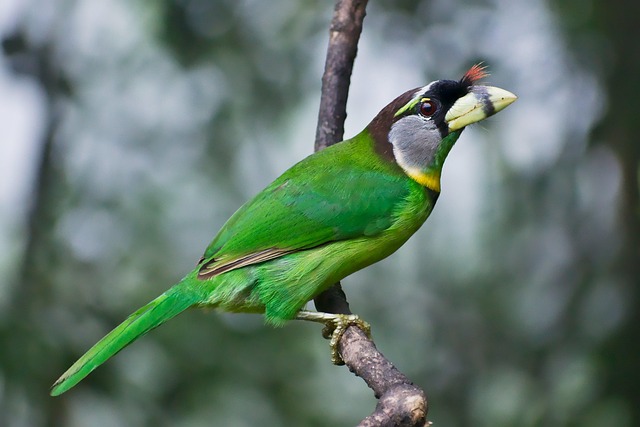
Barbet – The Colorful Forest Drummer with a Powerful Voice
Barbets are vibrant, medium-sized birds celebrated for their brilliant plumage, stout bills, and distinctive, repetitive calls that echo through forests, woodlands, and gardens. Found across Asia, Africa, and the Americas, these charismatic birds play a vital role in maintaining healthy ecosystems by dispersing seeds and helping forests regenerate. Their colorful appearance, energetic personalities, and rhythmic vocalizations make them a favorite among birdwatchers and nature lovers. Whether perched quietly on a fruiting tree or tirelessly excavating a nest cavity, Barbets are fascinating birds that bring life and color to the natural world.
Fun Facts
- Barbets get their name from the stiff, bristle-like feathers (“barbs”) around the base of their beaks.
- Many Barbet species produce loud, repetitive calls that can continue for several minutes without stopping.
- They excavate their own nesting cavities in dead or decaying trees using their powerful bills.
- Barbets are among the most important seed dispersers in tropical forests.
- Although primarily fruit eaters, they also consume insects and other small invertebrates.
- Their thick neck muscles help them chisel holes into wood with surprising efficiency.
- Some Barbet species are brilliantly colored with combinations of green, red, yellow, blue, and black.
- Both parents often share the duties of incubating eggs and feeding their chicks.
Scientific Information
| Category | Information |
| Common Name | Barbet |
| Representative Families | Megalaimidae (Asian Barbets), Lybiidae (African Barbets), Capitonidae (American Barbets) |
| Order | Piciformes |
| Class | Aves |
| Diet | Fruits, berries, figs, insects, spiders, small reptiles, and occasionally nectar |
| Length | 15–35 cm (6–14 inches), depending on the species |
| Weight | 30–200 grams |
| Wingspan | Approximately 25–45 cm |
| Lifespan | Around 8–15 years in the wild |
| Habitat | Tropical and subtropical forests, woodlands, orchards, gardens, plantations, and parks |
| Distribution | Asia, Africa, Central America, and South America |
Habits & Behavior
Barbets are primarily arboreal birds, spending most of their lives in trees where they forage, nest, and rest. They are usually seen perched quietly among dense foliage, making them easier to hear than to spot. Their loud, rhythmic calls often resemble repetitive knocking or drumming and may continue for long periods, especially during the breeding season.
These birds feed mainly on fruits, particularly figs, which make up a large portion of their diet. They also consume insects, caterpillars, beetles, spiders, and occasionally small reptiles or nectar. As they move from tree to tree eating fruit, they disperse seeds over wide areas, helping forests regenerate naturally.
Barbets are cavity nesters. Using their strong, chisel-like bills, they excavate nesting holes in dead or decaying tree trunks and branches. Both males and females usually participate in digging the nest, incubating the eggs, and raising the chicks.
Although generally solitary or found in pairs, Barbets become highly vocal during the breeding season. Males call repeatedly to establish territories and attract mates. Their calls are often among the most recognizable sounds in tropical forests.
Barbets are not strong long-distance migrants, and most species remain within their territories year-round. Their colorful plumage, specialized nesting behavior, and ecological importance as seed dispersers make them one of the most fascinating groups of tropical birds, contributing significantly to the health and diversity of forest ecosystems.