Redpoll – The Tiny Songbird of the Northern Wilderness
The Redpoll is a small, energetic finch famous for its ability to survive in some of the coldest environments on Earth. Found mainly across the northern regions of North America, Europe, and Asia, redpolls are specially adapted to life in Arctic and sub-Arctic habitats.
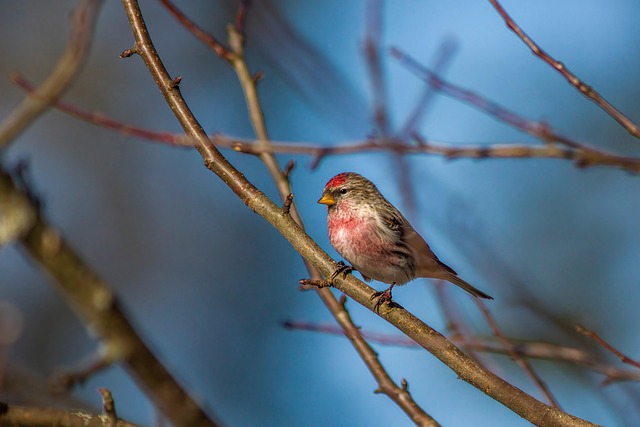
Redpolls are easily recognized by their small size, finely streaked plumage, and the characteristic red patch on the forehead. Depending on the species and individual, males may also show a rosy or pinkish wash across the breast. Their tiny bills are perfectly suited for opening seeds, especially those of birch and alder trees.
During winter, redpolls may travel southward in search of food and can sometimes appear in large, lively flocks. Their cheerful calls and rapid movements make them a delightful sight for birdwatchers.
Fun Facts
- Cold-weather specialists: Redpolls can survive remarkably low temperatures thanks to their dense plumage and specialized adaptations.
- A red forehead: The bright red crown is one of their most recognizable features.
- Seed specialists: They frequently feed on tiny seeds from birch, alder, and other plants.
- Highly social: Redpolls often gather in flocks, particularly during the colder months.
- Fluffy insulation: In extreme cold, they can fluff up their feathers to trap warm air close to their bodies.
- Amazing metabolism: Their bodies are adapted to maintain a high metabolic rate in freezing conditions.
- Northern distribution: Redpolls are among the finches particularly associated with Arctic and sub-Arctic regions.
- Irruptive movements: In some years, large numbers may move farther south when food becomes scarce in their usual northern range.
- Important seed dispersers: By consuming and moving seeds, redpolls can contribute to the natural movement of plant species.
Scientific Information
Common Name: Redpoll
Family: Fringillidae
Order: Passeriformes
Class: Aves
Diet: Primarily seeds; also buds and small invertebrates
Habitat: Arctic tundra, boreal forests, shrublands, and open woodland
Distribution: Northern North America, Europe, and Asia
Size: Approximately 11–14 cm, depending on species
Lifespan: Varies by species and environmental conditions
The name Redpoll generally refers to a group of small finches in the genus Acanthis. The group includes forms commonly known as the Common Redpoll, Hoary Redpoll, and Lesser Redpoll, although their taxonomy has been revised in recent years, with some authorities treating several forms differently.
Redpolls possess a short, conical bill that is well adapted for extracting small seeds. Their thick plumage provides excellent insulation, helping them withstand harsh northern winters.
Their diet consists largely of small seeds, particularly from birch and alder. They may also consume buds and small insects, especially during the breeding season.
Habits & Behavior
Redpolls are active and restless birds that spend much of their time searching for food. They often hang from branches or seed heads while extracting tiny seeds with their specialized bills.
During winter, they commonly form flocks, sometimes containing many individuals. These flocks move from one feeding location to another as they search for available food.
Redpolls are particularly well adapted to cold climates. When temperatures drop, they can increase their food intake and fluff their feathers to conserve body heat. They may also seek sheltered locations during severe weather.
During the breeding season, redpolls move into northern habitats where food resources and nesting conditions are favorable. Females typically build their nests in shrubs or low vegetation, using materials such as grasses, moss, and plant fibers.
Their vocalizations include soft calls and lively twittering sounds. Listening to a flock of redpolls can reveal a constant mixture of delicate calls as the birds communicate while feeding and moving together.
Listen to the Redpoll Sound
The gentle calls and lively chatter of Redpolls are a wonderful example of the sounds produced by northern finches. Their vocalizations can be especially noticeable when a flock gathers around a productive feeding area.