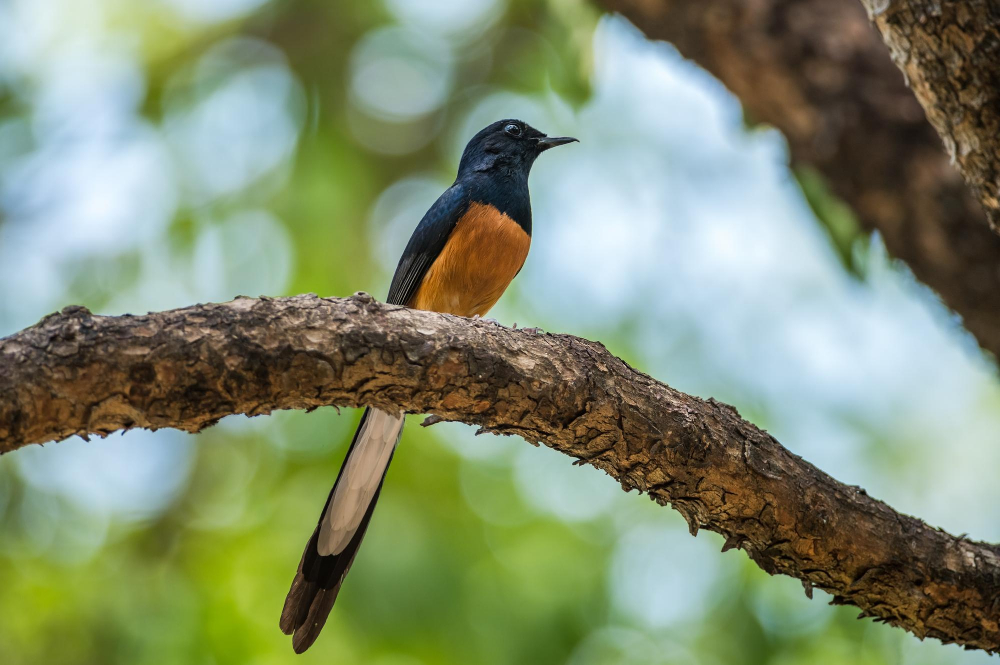
Shama Bird – The Melodious Songster of the Forest
The Shama is one of the world’s most admired songbirds, celebrated for its rich, melodious voice and graceful appearance. Found across tropical forests in South and Southeast Asia, the Shama is especially popular among bird enthusiasts for its incredible ability to produce complex songs and mimic other birds. Its striking black, chestnut, and white plumage, along with its elegant long tail, makes it a true jewel of the forest. Whether hidden among dense vegetation or perched on a low branch, the Shama’s beautiful song often reveals its presence long before it is seen.
Fun Facts
- The Shama is considered one of the finest singing birds in Asia.
- It can imitate the calls of other birds and even some environmental sounds.
- Male Shamas use their beautiful songs to attract mates and defend their territories.
- The White-rumped Shama is named after the bright white patch on its lower back.
- Shamas are native to countries including Bangladesh, India, Nepal, Myanmar, Thailand, Malaysia, Indonesia, and the Philippines.
- Birdwatchers and photographers highly prize sightings of Shamas because of their beauty and vocal abilities.
- Despite being excellent singers, they are often shy and prefer remaining hidden in thick forest undergrowth.
Scientific Information
| Category | Details |
| Common Name | Shama (commonly refers to the White-rumped Shama) |
| Scientific Name | Copsychus malabaricus |
| Family | Muscicapidae |
| Order | Passeriformes |
| Class | Aves |
| Diet | Insects, spiders, worms, small reptiles, berries, and fruits |
| Habitat | Tropical forests, bamboo groves, secondary woodlands, gardens, and parks |
| Distribution | South Asia and Southeast Asia |
| Average Length | 23–28 cm (9–11 inches), depending on tail length |
| Weight | 28–40 g |
| Lifespan | Around 8–15 years in the wild; longer in captivity |
Habits & Behavior
The Shama is primarily a solitary and territorial bird. It spends much of its time hopping along the forest floor or low branches, searching for insects and other small prey. Although naturally shy, it becomes remarkably vocal during the breeding season, filling the forest with a wide variety of clear whistles, trills, and melodious notes.
Shamas are active during the early morning and late afternoon when they forage for food. Their diet mainly consists of insects, spiders, earthworms, and occasionally small fruits and berries. They are agile hunters, often catching prey among fallen leaves or dense vegetation.
During the breeding season, males sing almost continuously to establish territories and attract females. Nests are usually built inside tree cavities, bamboo clumps, or natural crevices, where the female lays several eggs and incubates them while the male guards the territory.
Although they can adapt to gardens and parks near forests, Shamas thrive best in undisturbed woodland habitats with dense understory vegetation. Their remarkable vocal abilities, elegant appearance, and secretive nature have made them one of the most beloved songbirds among bird lovers worldwide.