Shikra – The Swift and Fearless Hunter of Forests and Urban Skies
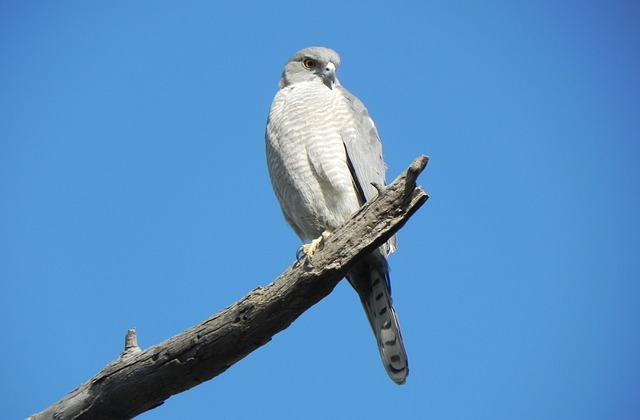
The Shikra is a small yet powerful bird of prey renowned for its lightning-fast hunting skills, sharp eyesight, and remarkable agility. Found across Asia and Africa, this elegant raptor thrives in forests, woodlands, farmlands, gardens, and even busy urban areas. With its sleek body, hooked beak, and piercing yellow eyes, the Shikra is a master ambush predator, capable of capturing birds, lizards, rodents, and large insects with incredible precision. Although often seen perched quietly on a tree branch or utility pole, it can launch into rapid, low-level flights through dense vegetation in pursuit of prey. Its adaptability and hunting prowess have made the Shikra one of the most successful and widespread small hawks in its range.
Fun Facts
- The name “Shikra” comes from a word meaning hunter or falcon in several South Asian languages.
- Shikras have exceptionally sharp eyesight, allowing them to detect small prey from great distances.
- They are agile enough to chase birds through dense trees and narrow spaces.
- Unlike many larger raptors, Shikras are commonly found in cities, parks, and residential neighborhoods.
- Their diet includes birds, lizards, frogs, rodents, bats, and large insects.
- During courtship, pairs perform spectacular aerial displays with fast dives and soaring flights.
- Juvenile Shikras have brown streaked plumage, while adults develop fine gray upperparts and barred underparts.
- They help maintain ecological balance by controlling populations of rodents and other small animals.
Scientific Information
| Category | Information |
| Common Name | Shikra |
| Scientific Name | Accipiter badius |
| Family | Accipitridae |
| Order | Accipitriformes |
| Class | Aves |
| Diet | Small birds, rodents, lizards, frogs, bats, insects, and occasionally snakes |
| Length | 26–30 cm (10–12 inches) |
| Weight | 120–220 grams |
| Wingspan | 55–70 cm |
| Lifespan | Around 8–15 years in the wild |
| Habitat | Forests, woodlands, scrublands, agricultural fields, gardens, parks, and urban areas |
| Distribution | South Asia, Southeast Asia, the Middle East, and sub-Saharan Africa |
Habits & Behavior
The Shikra is a highly active and solitary bird of prey that relies on stealth, speed, and surprise to capture its food. It usually hunts from a concealed perch, patiently watching its surroundings before launching into a rapid, low-level attack. Its short, rounded wings and long tail provide exceptional maneuverability, allowing it to weave through trees and dense vegetation while pursuing prey.
Its diet is highly varied and includes small birds, rodents, squirrels, lizards, frogs, bats, large insects, and occasionally small snakes. This adaptability enables the Shikra to thrive in both natural and urban environments.
Shikras are territorial throughout the breeding season. Males perform aerial displays involving soaring, circling, and diving flights to attract females and defend their nesting territories. They build stick nests high in trees, where the female usually lays three to five eggs. Both parents participate in raising the chicks, with the male primarily supplying food while the female incubates the eggs during the early stages.
These raptors communicate using sharp, repetitive whistles and high-pitched calls, especially during courtship and when defending their nests. Outside the breeding season, they are generally quiet and spend much of their time perched in observation.
Although many Shikra populations are resident year-round, some northern populations undertake short seasonal movements in response to weather and food availability. Their adaptability to urban landscapes has allowed them to coexist successfully with humans in many cities.
With its remarkable speed, precision hunting techniques, and fearless nature, the Shikra is one of the most efficient small birds of prey in the Old World. As a top predator of small animals, it plays an essential role in maintaining the balance of ecosystems across its wide geographic range.