Tailorbird – The Tiny Master Seamstress of the Bird World
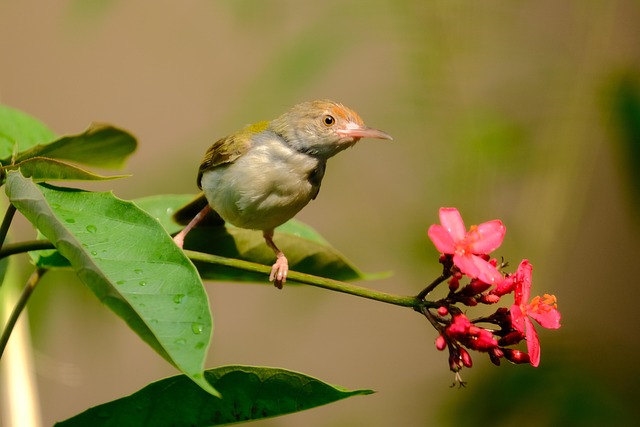
The Tailorbird is one of nature’s most remarkable little architects. Famous for its extraordinary ability to “sew” leaves together to create a secure nest, this tiny songbird combines intelligence, agility, and craftsmanship in a way that has fascinated bird lovers for generations. Despite its small size, the Tailorbird is energetic, fearless, and highly vocal, filling gardens, forests, and parks with its cheerful melodies. Found across much of Asia, these delightful birds are often easier to hear than to see as they dart swiftly through dense foliage in search of insects and other small prey.
Fun Facts
- The Tailorbird gets its name from its unique nesting technique, stitching living leaves together using plant fibers, spider silk, or fine threads.
- It uses its sharp beak like a tiny sewing needle to pierce holes through leaf edges.
- Although very small, Tailorbirds are surprisingly loud and can be heard long before they are spotted.
- Most Tailorbirds spend much of their time hidden among bushes and shrubs.
- They constantly flick and raise their tails while moving through vegetation.
- Tailorbirds play an important role in controlling insect populations.
- Their nests are soft and comfortable, lined with cotton, feathers, and fine grasses.
- They are active throughout the day and rarely remain still for long.
Scientific Information
| Category | Information |
| Common Name | Tailorbird |
| Scientific Name | Orthotomus sutorius (Common Tailorbird) |
| Family | Cisticolidae |
| Order | Passeriformes |
| Class | Aves |
| Diet | Insects, spiders, caterpillars, small fruits, nectar |
| Length | 10–14 cm (4–5.5 inches) |
| Weight | 6–10 grams |
| Wingspan | About 12–16 cm |
| Lifespan | Around 5–8 years in the wild |
| Habitat | Gardens, forests, scrublands, parks, plantations, and urban greenery |
| Distribution | South Asia and Southeast Asia |
Habits & Behavior
Tailorbirds are highly active and inquisitive birds that spend most of their day searching for insects among leaves, branches, and shrubs. They move quickly with short hops and rapid flights, often remaining hidden in dense vegetation.
Their most remarkable behavior is nest construction. During the breeding season, the female carefully pierces holes along the edges of large leaves and stitches them together using plant fibers, spider silk, or cotton-like materials. This creates a protective cradle where a soft inner nest is built for the eggs and chicks.
Tailorbirds are territorial and communicate using loud, repetitive whistles and sharp calls. Males frequently sing from exposed perches to defend their territory and attract mates.
Their diet consists mainly of insects, spiders, caterpillars, and other tiny invertebrates, making them valuable natural pest controllers. They may also feed on nectar and small fruits when available.
These birds are usually seen alone or in pairs, although they occasionally join mixed-species feeding flocks. Their excellent camouflage and preference for thick vegetation help them avoid predators despite their small size.
Tailorbirds are adaptable and thrive in both natural forests and human-altered environments such as gardens and city parks. Their intelligence, remarkable nest-building skills, and cheerful songs have made them one of the most admired small birds throughout Asia.